
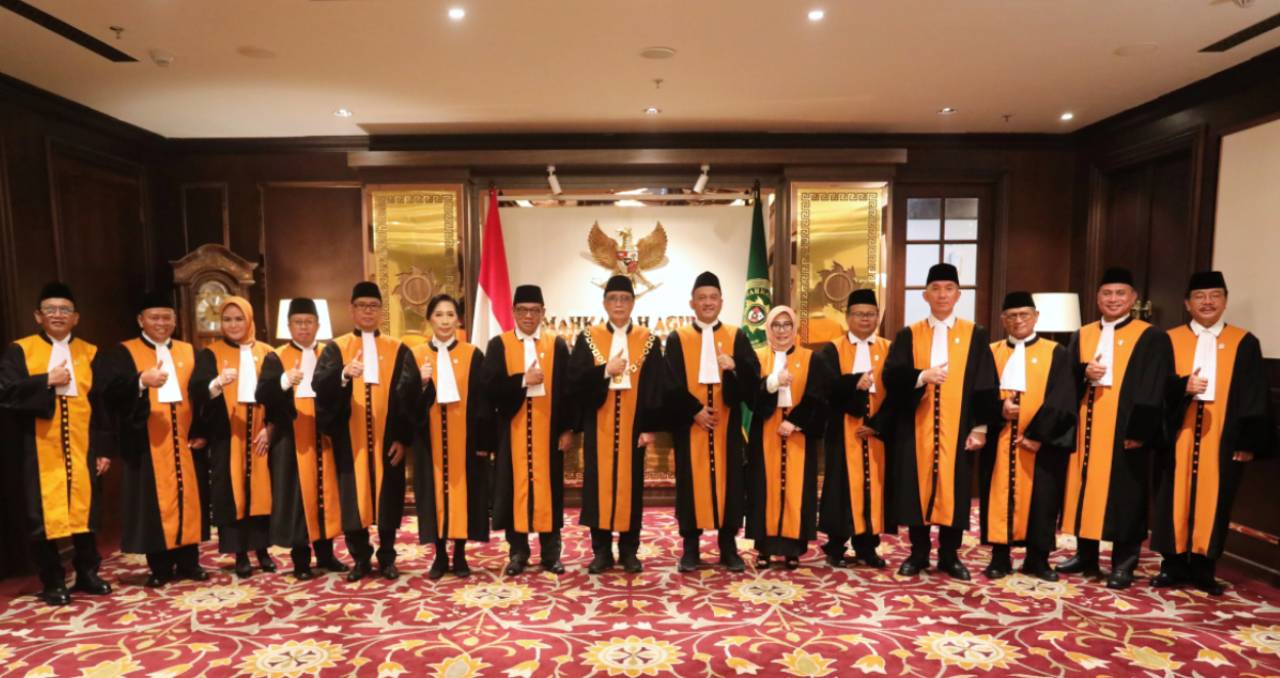
Jakarta, 4 September 2026 — Transparency International (TI) Indonesia views with serious concern the growing public doubts over the integrity of a number of figures who passed the selection process for Supreme Court justice candidates. This issue must not be seen merely as a controversy about certain individuals. What is at stake is far greater: the credibility of the selection process, the integrity of the Supreme Court, and public trust in the judiciary — particularly after the public has witnessed a series of corruption scandals involving judges in recent years.
TI Indonesia Secretary General Dadang Trisasongko emphasized that the position of Supreme Court justice demands a higher standard than mere technical legal competence.
“A Supreme Court justice sits at the pinnacle of judicial power, so legal competence alone is not enough. Integrity, independence, track record, and the courage to keep a distance from political and economic interests must be non-negotiable requirements,” said Dadang.
According to Dadang, public doubts over a candidate’s track record should be grounds for deeper scrutiny, not something considered settled simply because a candidate has met administrative requirements. Competence matters, but what matters more is integrity and freedom from vested interests.
“The simplest question is this: does the public have strong grounds to entrust the highest judicial power to the figures selected? If that question cannot be answered convincingly, then there is a problem in the selection process,” he said.
Judicial Independence and the Business Environment
Izza Akbarani, TI Indonesia’s researcher on Democratic and Participatory Governance, stated that the issue of Supreme Court justices’ integrity is closely tied to judicial independence. According to her, independence is not merely freedom from government intervention, but also includes judges’ ability to avoid conflicts of interest, business interests, power networks, and other forms of influence that could threaten the objectivity of their rulings.
“A trusted judiciary is part of the economic and justice infrastructure. The business sector needs certainty that contracts will be honored, property rights protected, government actions subject to review, and disputes decided based on law — not on power, money, or proximity to influence,” said Izza.
According to Izza, when the integrity and independence of the courts are in doubt, businesses no longer weigh only market risk, but also institutional risk. In the long run, this raises transaction costs, drives the search for protection through power networks, undermines fair business competition, and reduces the attractiveness of long-term investment.
A Moratorium for Systemic Correction
TI Indonesia views the problems that have emerged in the current selection process as evidence of the need for a more fundamental correction to the mechanism for recruiting Supreme Court justices. TI Indonesia supports the Supreme Court in pursuing a temporary moratorium on filling Supreme Court justice positions until the recruitment and selection system for Supreme Court justice candidates is evaluated and improved.
“A moratorium is not meant to weaken the Supreme Court. On the contrary, this is an opportunity to strengthen it. It is better to delay filling positions in order to fix the system than to rush to fill them at the risk of placing figures whose integrity is in question on the highest judicial body for years to come,” Dadang said.
Dadang said the moratorium period should be used by the Supreme Court, the Judicial Commission, the House of Representatives (DPR), and the government to build a mechanism capable of genuinely testing each candidate’s integrity, independence, competence, track record, potential conflicts of interest, and the reasonableness of their wealth.
TI Indonesia also calls for public input to become a substantive part of the selection process. Credible information regarding integrity concerns about candidates must be verified and clarified openly and proportionately. The methods, indicators, and basis for assessing integrity also need to be made more transparent, so the public understands how the selecting institutions ensure a person’s fitness to hold the highest judicial power.
“Integrity must be placed on equal footing with legal competence. High technical ability must never be a reason to overlook serious concerns about a candidate’s integrity, independence, conflicts of interest, or ethical track record,” said Izza.
TI Indonesia also reminds the House of Representatives (DPR) that the process of selecting Supreme Court justices must not become an arena for political transactions or compromises. The stage at the DPR must serve as the final mechanism to ensure candidate quality and safeguard public trust in the Supreme Court.
“In the end, the issue is not only about who is elected as a Supreme Court justice. The more fundamental question is whether our selection process is robust enough to prevent unfit individuals from obtaining the highest judicial power. Trust in the courts begins with trust in the people chosen to serve as judges,” Dadang concluded.
Contact Person:
Izza Akbarani — Researcher, Democratic and Participatory Governance, Transparency International Indonesia
+62 811-8869-711