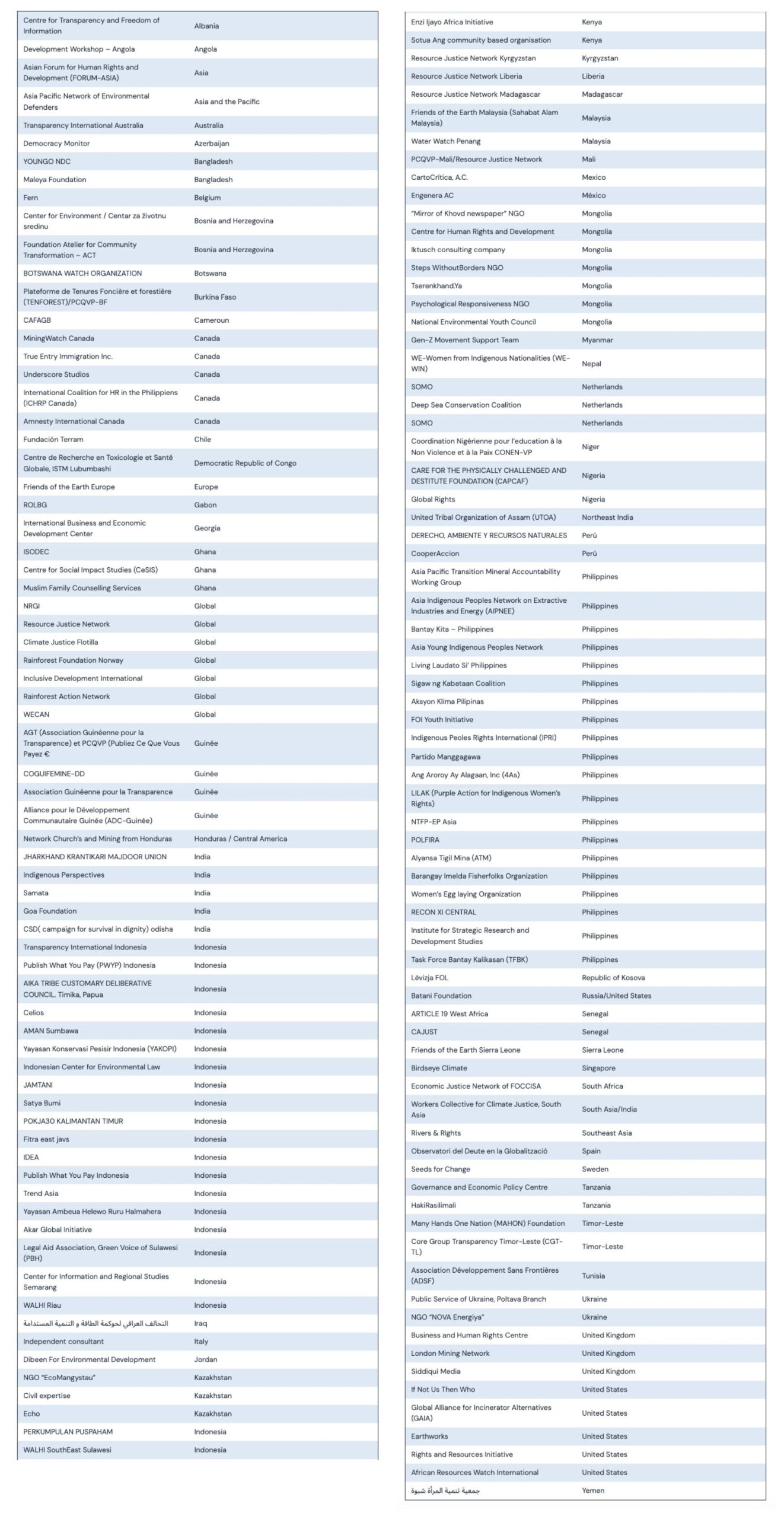
 More than 150 organisations, from Asia-Pacific and across the globe, stand united in Antalya to ensure human rights are at the heart of the Just Transition Mechanism delivery. As countries advance their Paris Agreement commitment through electrification goals, human rights safeguards must extend to entire supply chains of critical energy transition minerals.
Antalya, Türkiye – November 8, 2026
Dear Excellencies,
As a global coalition, we call on COP31 leaders to place human rights, protection and tangible benefits for all rights-holders across the transition mineral supply chain to be at the epicenter of the Just Transition Mechanism’s (JTM) delivery.
To truly achieve equity, the JTM must move from commitments to implementation by integrating concrete functions, modalities and institutional arrangements which protect, empower and ensure shared prosperity for Indigenous Peoples, as distinct collective and individual rights-holders, and other mining-affected communities, including explicit operationalisation of Paragraph 12(i) and Paragraph 18 of Decision 2/CMA.7 of the Just Transition Work Programme.
In alignment with the civil society letter on the Just Transition Mechanism, and formal endorsement of its core tenets, we are issuing this additional targeted call for direct support to operationalise mineral principles within the Just Transition Work Programme.
We call for the key messages in the Just Transition Work Programme negotiations to have explicit inclusion of the United Nations Critical Energy Transition Mineral principles and implementation of financing, technical support, national policy guidance, and institutionalised, meaningful participation for rights-holders impacted across the green technology and transition mineral supply chain.
We urge world climate leaders to operationalise this call to action through the establishment of the following demands:
-
- Explicitly anchor the United Nations Secretary-General’s (UNSG) Critical Energy Transition Minerals (CETM) Panel Principles into the key messages of the JTWP negotiation decision text, embedding the principles across all relevant national just transition policy plans, international cooperation mechanisms and supply chain frameworks. Ensure the principle of non-regression is upheld across the transition mineral supply chain and JTM, preventing any rollback of human rights protections.
- Ensure the Just Transition Mechanism delivers strong safeguards and benefits for Indigenous Peoples and frontline mining communities which includes: explicit inclusion that the JTM’s risk identification and policy guidance cover mineral extraction; national policy guidance to effectively integrate rights in mineral laws; and provide direct access to financial and technical support for affected communities
- Recognise Indigenous Peoples, as distinct collective and individual rights-holders, and other mining-affected communities across the length of the green technology supply chain as rights-holders, decision-makers and primary beneficiaries in the Just Transition Mechanisms’ delivery
- Operationalise paragraph 12(i) through measurable protections for Indigenous Peoples’ self-determination, Free, Prior and Informed and Continuous Consent across the project life cycle and the right to approve, establish conditions for, withhold or withdraw consent, with protection from reprisals and access to effective remedy.
- Embed mining accountability, shared inheritance and inclusive good governance at the core of the transition. Address corporate and government impunity to social and environmental rights violations and corruption through robust transparency and accountability measures. Implement policies that ensure communities are the primary beneficiaries of shared prosperity, seen through fair job creation, local value addition, equitable benefit sharing, and access to renewable energy for secure, affordable power.
- Ensure the clean energy transition does not depend on coal. Governments must phase out coal dependence across transition mineral supply chains. This includes ending reliance on captive coal-fired power plants to ensure that the production of clean energy technologies does not perpetuate fossil fuel dependence.
- Uphold common but differentiated approaches and require high-consuming countries to reduce excessive primary mineral demand through robust measures of accountability on material efficiency and recycling, while preventing shifting waste and environmental harm to Global South climate vulnerable producer countries.
- Uphold labour rights across transition mineral value chains by ensuring living wages, secure employment and safe working conditions, with zero tolerance for exploitation.
- Establish a global moratorium on deep-sea mining and on the opening up of new extractive frontiers in the name of transition minerals.
A CRITICAL MOMENT FOR JUST TRANSITION DELIVERY FOR FRONTLINE COMMUNITIES
At COP30, critical historic victories were secured within the Just Transition Work Programme negotiations. Driven by civil society constituencies, the adoption of the Just Transition Mechanism marked a monumental step forward for rights inclusion in UNFCCC. Further, the Indigenous Peoples’ caucus leadership secured historic wins for Indigenous Peoples’ rights under Paragraph 12i) and Paragraph 18. Despite these profound achievements, transition mineral governance was ultimately stripped from the final COP30 texts by Parties, leaving a critical gap.
In June 2026, the United Nations COP31 Presidency announced a pledge to increase electrification by 35% by 2035, with rapid growth in electric vehicles and digital infrastructure accelerating electricity demand and consumption. Despite over a decade passing, multilateral efforts within the UN climate summit have failed to address the human and environmental impacts that mining associated with global decarbonisation and green technology goals have on climate-vulnerable mining-affected communities and producer countries in the Global South.
World leaders must address the outcomes of the 6th Just Transition Work Programme Dialogue thematic focus on green industrialisation, including explicit recognition of the mineral impacts of just transitions for Indigenous Peoples, mining-affected communities, women, workers, farmers, fisherfolk and marginalised groups hosting the minerals targeted for the transition. The materiality of the Paris Agreement and COP31’s Presidency electrification goals must ensure that mineral exploitation for climate targets does not fuel climate catastrophe, rights violations, corruption, militarism, or ecological destruction.
FROM COP30 TO COP32: ASIA PACIFIC DEMANDS TRANSITION MINERAL JUSTICE
The Asia Pacific region is the paradox at the heart of the global energy transition, serving as both its vital engine and its primary victim of climate injustice. Holding a quarter of the planet’s mineral wealth, the Asia Pacific produces over half of the world’s nickel and 60% of rare-earth reserves, while also bearing the heaviest burdens of intensifying climate inequity.
Since 2010, 1,226 allegations of human rights abuses have been linked to the transition minerals industry, with a 73% surge in 2025 alone. Mineral demand has intensified dispossession and land grabs as nearly 54% of transition minerals sit nearby or on Indigenous lands. Mining also remains one of the deadliest sectors for defenders. Further, the extractive sector remains a significant contributor to the climate crisis, with mineral supply chains coal-dependent, responsible for 8 to 28% of global GHG emissions and contributing to the destruction of critical climate mitigating ecosystems. In Indonesia, the nickel boom is largely powered by captive coal, with capacity set to exceed Australia’s entire coal fleet.
Driven by an unprecedented convergence of mining expansion for the green energy transition, AI data infrastructure, and global militarisation, the mining industry acts as a direct vector for resource wars, forced displacement, and militarisation. Meanwhile the climate footprint of the world’s militaries, estimated at 5.5% of global GHG emissions, remains largely unreported under UNFCCC. Access to information is also restricted and participatory decision making eroded, as affected communities are excluded from projects that shape their livelihoods. Transformative, systems-based and community-centred change is fundamental to a just transition. Reparations for historic harms must anchor new mineral governance.
As leaders of grassroots movements, frontline communities, national coalitions, and regional alliances from 54 countries and globally, we call on State Parties to explicitly include the United Nations Secretary Panel on Critical Energy Transition Minerals principles in the Just Transition Work Programme and ensure Indigenous Peoples and affected communities across the green energy supply chain are at the heart of climate action.
We cannot achieve climate justice without supply chain justice. Looking ahead, we urge COP32 leaders in Addis to formalise global mineral traceability and rights-based mineral governance as legally binding, core enforcement mechanisms within the Paris Agreement.
Signatories: